
The History of the Apothecary
History of the Apotheca(ry)
Apotheca is the place where plants, remedies, and useful preparations are gathered and kept.
Apothecary is the practice of working with those plants carefully, traditionally, and with purpose.
These words honor a long lineage of herbal knowledge shaped by land, community, and the often-unrecognized work of women and caregivers who preserved this wisdom through generations. Thank you.
Ancient Herbal Origins
The roots of the apothecary tradition extend thousands of years into ancient civilizations. Egyptian, Greek, and Chinese medical texts documented hundreds of plants used for healing. Early herbalists cataloged plant preparations, tinctures, infusions, and botanical extracts that formed the foundation of later herbal medicine.
The apothecary tradition did not begin with shops, jars, or labels. It began much earlier, in the close observation of land, seasons, and the effects of plants on the body. Across ancient cultures, people recorded, tested, and passed down plant knowledge as part of everyday survival and care. In Egypt, Greece, India, and China, medicinal plants were cataloged and described in early texts that shaped later herbal practice. Ancient herbals documented preparations such as infusions, tincture-like extracts, poultices, and dried plant materials, forming the foundation for much of what would later become organized pharmacy and botanical medicine.
Geography mattered from the very beginning. Herbal practice developed in direct conversation with climate, terrain, and the plants that could be gathered locally. River valleys, mountain regions, forests, and cultivated gardens each produced their own plant traditions. What healed in one place often differed from what healed in another, not because one culture cared more deeply than another, but because each community learned from the living landscape available to it. This place-based knowledge is one of the oldest and most enduring truths in herbal history: people heal in relationship with the ecosystems that sustain them.
Women were also central to this earliest layer of herbal knowledge, even when formal written histories failed to credit them fully. Much of plant medicine was preserved in household, village, and intergenerational settings — among mothers, grandmothers, caregivers, midwives, and community healers. Long before medicine was institutionalized, knowledge of herbs often lived in the domestic sphere and moved through oral teaching, practical care, food preparation, childrearing, and women’s health traditions. That history matters deeply. Listening to women is not a modern correction to herbal practice; it is a return to one of its oldest lineages.
For Perky Foraging Company, these ancient roots are more than historical background. They help define an approach: learning from the land, respecting regional plants, and remembering that herbal practice has always been tied to care, observation, and community responsibility. The old apothecary tradition was never only about substances. It was about relationships — between people and plants, between families and memory, and between human need and ecological limits.
Medieval Apothecaries
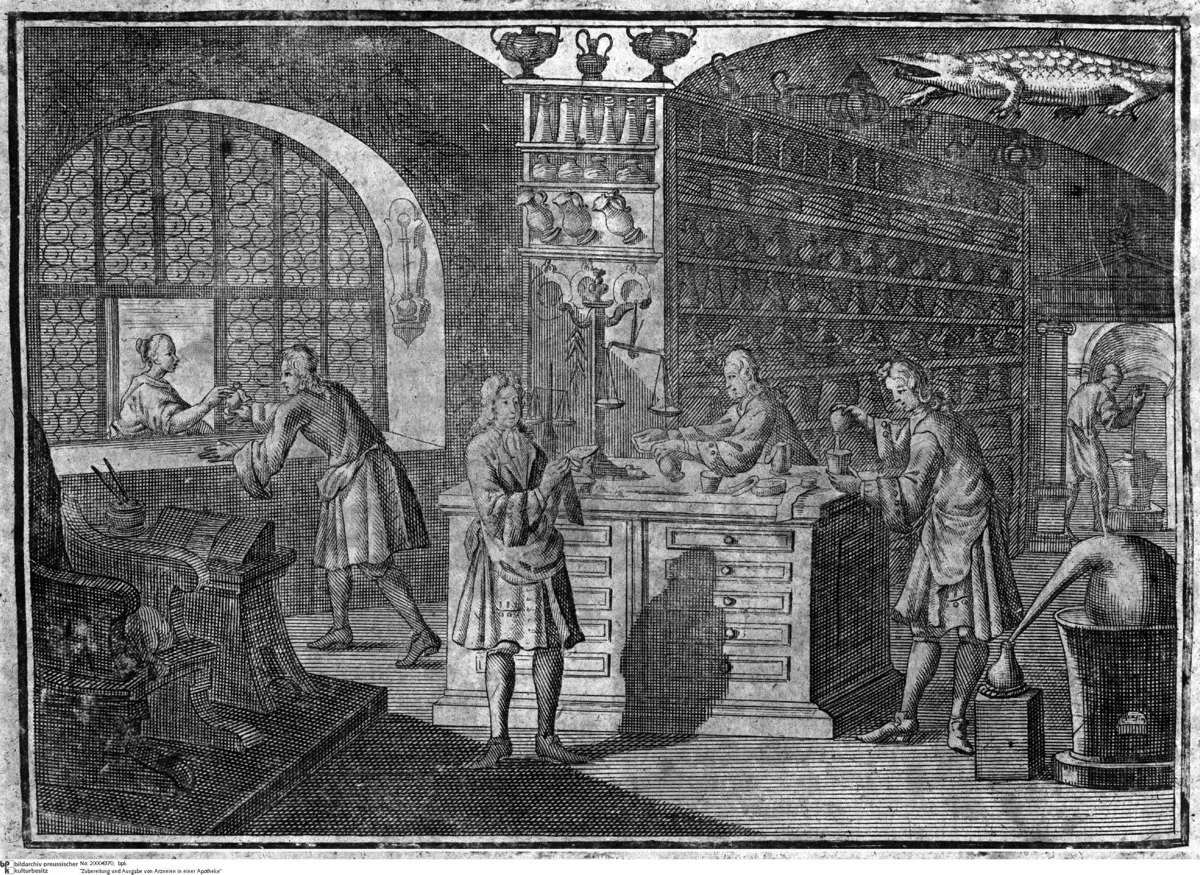
During the medieval period, the apothecary became a more recognizable figure in public life. In Europe, apothecaries were associated with the preparation and dispensing of medicinal materials, and over time their role became more distinct from that of physicians and grocers. Shops, storage systems, dried herbs, roots, bark, seeds, minerals, and compounded preparations became part of a more formalized medical culture. In that sense, the medieval apothecary stands at an important threshold between older folk practice and the later professionalization of pharmacy.
But the medieval story is larger than the shop alone. Across Europe and the broader Mediterranean world, healing knowledge also lived in monasteries, home gardens, kitchens, convents, and villages. Monastic herb gardens preserved and cultivated important medicinal species, while household and local healers continued to serve everyday needs at the community level. In many places, access to formal medical care was limited, so practical herbal knowledge remained essential to ordinary life. Healing was not only an elite or urban activity — it was local, social, and deeply embedded in communal structures.
Women were indispensable in this world, even when they were excluded from formal authority. Women maintained household remedies, cared for children and elders, attended births, and transmitted practical plant knowledge through daily life. Figures such as Hildegard of Bingen also show that women contributed to medicinal and botanical understanding in more visible written ways, even within institutions that limited women’s formal participation. The broader historical truth is that women’s healing labor often sustained communities whether or not official records treated it as scholarship.
This is one reason the medieval apothecary remains meaningful today. It reminds us that plant medicine has always had two dimensions at once: the prepared remedy and the human network around it. The jar on the shelf mattered, but so did the person who knew when to gather, how to dry, what to mix, who needed help, and how to care for a household or village through illness and hardship. That combination of skill, stewardship, and service still resonates strongly with a small, land-based herbal practice.
Victorian Botanical Medicine
By the eighteenth and nineteenth centuries, botanical medicine entered a new phase of expansion. Plant knowledge was no longer carried only through oral tradition, household practice, or local apothecary work; it increasingly moved through printed herbals, botanical illustration, gardens, collections, and institutional study. Accuracy in plant identification became more important as medical botany grew more systematic. This period helped shape the visual and descriptive language that many later herbal and botanical reference works would inherit.
Geographically, this era was shaped by gardens, trade routes, colonial exchange, and expanding plant collections. Physic gardens and botanical gardens became sites where medicinal plants could be studied, compared, and documented. They also became places where local and global plant knowledge intersected, sometimes productively and sometimes through unequal systems of extraction and empire. That tension is part of the history too: botanical medicine expanded through careful study, but often within political structures that did not distribute credit or power fairly.
Women’s involvement becomes especially visible here. Elizabeth Blackwell’s A Curious Herbal, published between 1737 and 1739, was the first significant herbal produced by a British woman and a major achievement in medical botany and botanical illustration. Her work helped readers develop more exact knowledge of medicinal plants at a time when correct identification could have serious consequences. Blackwell’s example matters not only because of the book itself, but because it shows how women contributed expertise, precision, and scientific labor even when access to formal education and societies was restricted.
For a contemporary herbal business, this period offers both inspiration and caution. It demonstrates the value of careful identification, accurate records, and respect for plant specificity. At the same time, it invites a more honest historical lens — one that recognizes whose labor was visible, whose labor was hidden, and how botanical knowledge was shaped by power. In our view, a modern apothecary should inherit the best of this period: rigor, observation, and deep botanical respect, while also restoring recognition to the caregivers, gatherers, and women whose knowledge has too often been treated as secondary.
American Herbal Traditions
American herbalism emerged through cultural contact, adaptation, and exchange. European settlers brought familiar remedies and self-help medical traditions with them, but they also encountered entirely new landscapes and new plants. To survive and care for themselves in these environments, they learned from the botanical knowledge already present on this continent. Indigenous peoples’ understanding of local flora played a vital role in shaping American botanical medicine, and many plants later adopted into Euro-American practice came through that intercultural transfer.
This makes geography especially important in the American story. Herbal traditions in North America are inseparable from region: forest, field, wetland, mountain, plain, and creek corridor all shaped what people gathered and how they used it. The medicinal plant traditions of the Northeast differ from those of the Southeast, the Midwest, or the Southwest because the plants themselves differ. In Pennsylvania and the mid-Atlantic, this place-based history is particularly meaningful. A local herbal practice is strongest when it respects not only the plants, but the ecological and cultural context in which those plants are known.
Women again stand near the center of the story. In American domestic medicine, many remedies were prepared, stored, and used in the home, and women were often the practical keepers of that knowledge. Household medicine, community caregiving, and herbal self-reliance were deeply connected. Duke’s history-of-medicine exhibit notes that healing at home remained important across class, culture, and race, and that this tradition of self-help persisted long after formal medicine became more common. That reality helps explain why women’s knowledge remained so influential: they were often the ones maintaining continuity between book knowledge, household practice, and lived care.
For Perky Foraging Company, this history has direct relevance. Working with plants in Southeast Pennsylvania is not an abstract herbal exercise; it is participation in a regional American tradition shaped by land, community, adaptation, and responsibility. It also calls for humility. Any American apothecary story that ignores Indigenous knowledge, women’s labor, and local ecological limits is incomplete. A better version of this tradition is one that acknowledges its many teachers and remains accountable to the places where the plants still grow.
The Modern Apotheca
The modern Apotheca is not simply a revival of an old aesthetic. At its best, it is a thoughtful continuation of older plant traditions under present-day ecological conditions. Today’s herbal makers and foragers often return to local plants, small-batch methods, and slower preparation practices because those approaches preserve quality, transparency, and relationship to place. Modern apothecary work frequently emphasizes sustainable harvest, traceability, and respect for the difference between using plants and exhausting them. That shift reflects a broader recognition that herbal practice must now answer not only to tradition, but to conservation and stewardship as well.
Geography remains central here, just as it was in earlier eras. A meaningful modern Apotheca is not placeless. It is shaped by watershed, season, soil, local species, and the reality of what can be gathered responsibly in a specific region. For a Southeast Pennsylvania practice, that means paying attention to disturbed-ground species, edges, hedgerows, woodlots, creek systems, and the mixed native-naturalized plant communities that define this landscape. It also means seeing foraging not as extraction, but as a form of observation, restraint, and ongoing relationship.
Community and women’s leadership should be especially visible in the modern version of this work. Historically, plant knowledge has too often been stripped from its caregivers and repackaged without context. A healthier path forward is more relational: listening carefully, valuing lived experience, honoring women’s voices in healing traditions, and recognizing that community knowledge is not less serious than institutional knowledge. In many ways, the future of herbal practice depends on recovering exactly those forms of listening that older systems overlooked or undervalued.
That is where the idea of a modern Apotheca becomes meaningful for Perky Foraging Company. It is not about nostalgia alone. It is about creating herbal preparations with integrity while honoring land, tradition, and community. It is about making something carefully, transparently, and in proportion to what the landscape can support. And it is about remembering that herbal work, at its heart, is not only about products. It is about care — for plants, for place, for people, and for the quieter forms of knowledge that deserve to be heard.